DATE: November 14, 2015
HISTORICAL
SITE: Springfield National
Cemetery

MARKER
#: 99001045
 DEDICATED: August 27, 1999
"This national cemetery has been listed in The National
Register of Historic Places"
MARKER
PLACED BY: United States
Department of the Interior
PERSONAL
REFLECTIONS:
“It is foolish and wrong to mourn the men who died. Rather
we should thank God that such men lived” – General
George S. Patton

I think I’ve mentioned before that there is this fascination
when one place I’ve blogged about becomes connected to another. That’s the case
with the Springfield National Cemetery.
This area was home to the Kickapoo Indians and the area
around the cemetery was known as Kickapoo Prairie. Missouri was truly the edge
of civilization before people started making their way west. We’ve seen, as
with the Patee hotel, that people knew they were going into or coming out of the wilderness.

Slavery, among other issues, had always been a dividing
point in the United States and it came to a head on April 12, 1861, when the
Confederates opened fire on the Union garrison at Fort Sumter, South Carolina.
Not long after, the Missouri legislators met and voted
against secession but said if the north declared war on the south, then they
would fight for the Confederacy.
 In August 1861, the first major engagement west of the
Mississippi River took place at Wilson’s Creek, about 15 miles north of the
cemetery. The win really went to the Confederates but they failed to push
forward and gave the federal military time to regroup. The south would never
really hold Missouri although the state was full of southern sympathizers.
In August 1861, the first major engagement west of the
Mississippi River took place at Wilson’s Creek, about 15 miles north of the
cemetery. The win really went to the Confederates but they failed to push
forward and gave the federal military time to regroup. The south would never
really hold Missouri although the state was full of southern sympathizers.
The city bought 80 acres on the outskirts of Springfield.
The cemetery was named Springfield National Cemetery, not because it was part
of the federal government, but because that was the name of the street that
used to run on the south border of the land. The street disappeared when the
cemetery was expanded.

 The civic leaders gave the U.S. government the choice of
areas within the cemetery for the sole purpose of burying Union soldiers and
most had fought at Wilson’s Creek. The cemetery opened in 1867, and soldiers
buried around the area were disinterred and reburied here.
The civic leaders gave the U.S. government the choice of
areas within the cemetery for the sole purpose of burying Union soldiers and
most had fought at Wilson’s Creek. The cemetery opened in 1867, and soldiers
buried around the area were disinterred and reburied here.
In the end, there would be 1,514 Union soldiers buried with
719 unknowns. There were 566 Confederates and the majority of those were
unknown. There’s something about standing there and you can see a sea of
“Unknown Confederate Soldier” tombstones.


There are several monuments within the cemetery. The first
one you see was placed in 1888 to the memory of Union General Nathaniel Lyon,
the commanding officer at Wilson’s Creek and the 1st Union General to die in
the Civil War.
 A few years later, in 1901, a monument to Confederate
General Sterling Price was raised. Price was once the Governor of Missouri and
the Confederate Commander at Wilson’s Creek.
A few years later, in 1901, a monument to Confederate
General Sterling Price was raised. Price was once the Governor of Missouri and
the Confederate Commander at Wilson’s Creek. A local doctor, T.J. Bailey, had wanted a monument put up
upon his death so in 1907 it was placed with the inscription “erected under the
provisions of the last will of Dr. Thomas Bailey to show his love for the Union
and its gallant defenders”
A local doctor, T.J. Bailey, had wanted a monument put up
upon his death so in 1907 it was placed with the inscription “erected under the
provisions of the last will of Dr. Thomas Bailey to show his love for the Union
and its gallant defenders”
But this wasn’t the only cemetery around. Right next to the
National Cemetery, there was a smaller one for Confederate soldiers. In 1911,
the Confederate Cemetery Association donated 6 acres with the stipulation that
only men who fought on the side of the Confederacy could be buried there. An
Act of Congress in 1911 ordered the Secretary of War to accept the confederate
cemetery as part of the Springfield National Cemetery.
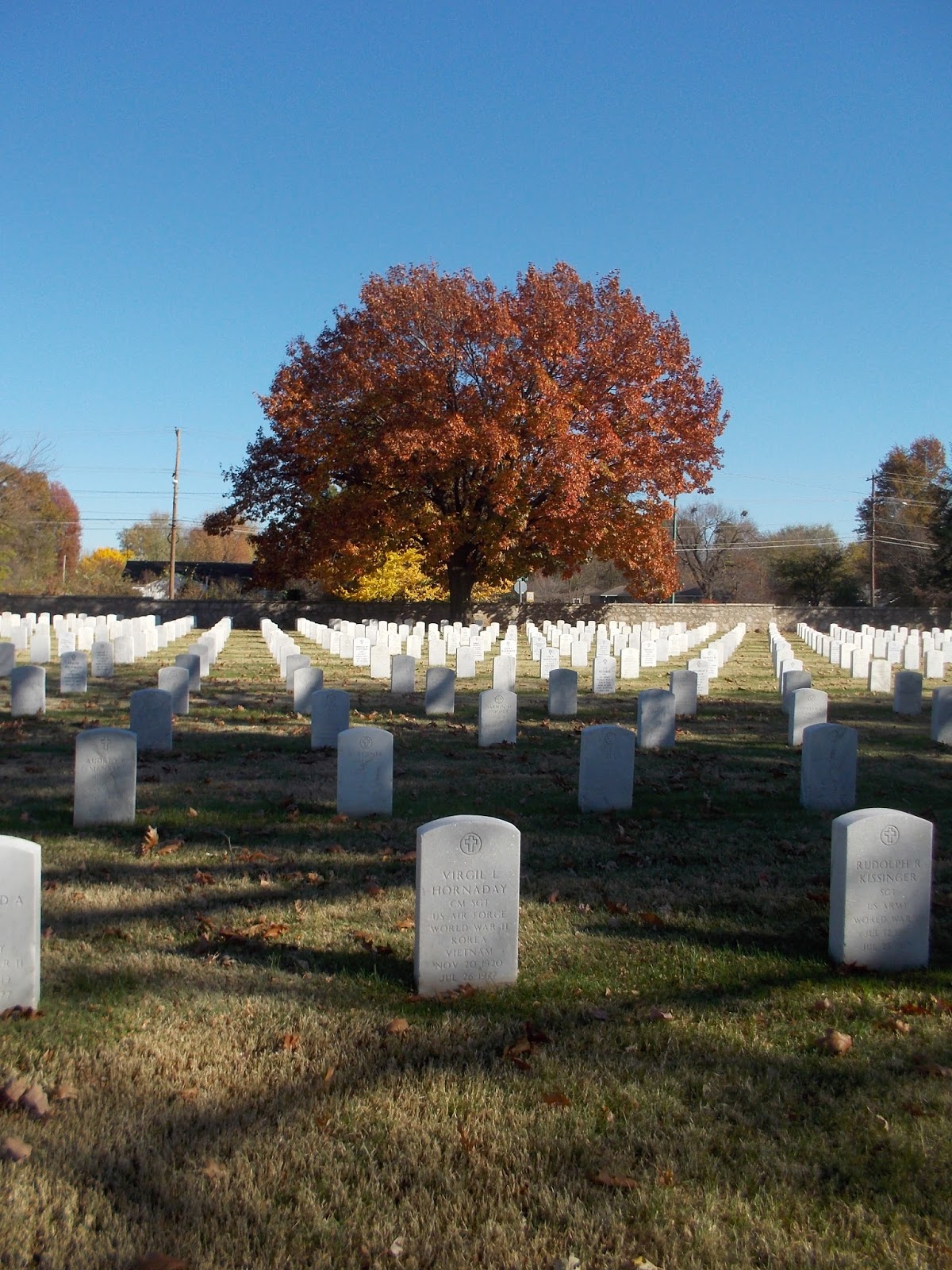
After WWII, with a lot of space on the Confederate side, the
Dept. of Veterans Affairs asked permission of the Confederate Association to
bury soldiers from other wars in the area. The permission was given except for
a smaller walled off section.
In 1958, the Daughters of the Confederacy put up a monument
to all the unknown Confederate soldiers who died at Wilson’s Creek.
It wasn’t until the 1980’s, with amendments to the agreement
with the Confederate Cemetery Association, that all veterans were eligible to
be buried in the smaller Confederate section.
Yeah, they waited until no one was alive who could argue the
point, but then again, who would be buried there as all Confederate soldiers
were gone at this point.
 There are soldiers buried here from most of America's wars
including one revolutionary war veteran. Private William Freeman, born in North
Carolina, was a scout for General George Washington. In 1912, his remains were
removed from the family farm and re-interred here.
There are soldiers buried here from most of America's wars
including one revolutionary war veteran. Private William Freeman, born in North
Carolina, was a scout for General George Washington. In 1912, his remains were
removed from the family farm and re-interred here.
A monument was erected by the Pearl Harbor Survivors Association in 1992 as a tribute to those who died in the attack on Pearl
Harbor in 1941 and in 1999, the Sons & Daughters of the American Revolution
honored those who died in the revolution with another monument.
 In addition, five Buffalo Soldiers are buried here. These
were members of African American army regiments created after the Civil War.
They were the protectors of settlers moving west, they built and renovated Army
posts and camps, and maintained law and order in the western expanses of the
country.
In addition, five Buffalo Soldiers are buried here. These
were members of African American army regiments created after the Civil War.
They were the protectors of settlers moving west, they built and renovated Army
posts and camps, and maintained law and order in the western expanses of the
country.
There are also 5 recipients of the Medal Of Honor buried in
the cemetery. This is our nation's highest military decoration, given for
"conspicuous gallantry and intrepidity at the risk of his life above and
beyond the call of duty.”
1999 was also when the cemetery was given the designation
and put on the register of historic places.
“I don't have to tell you how fragile this precious
gift of freedom is. Every time we hear, watch, or read the news, we are
reminded that liberty is a rare commodity in this world.” – President Ronald Reagan


