Showing posts with label Oklahoma. Show all posts

Sunday, June 21, 2015

Old Baptist Mission & Cemetery - Westville, Oklahoma


DATE VISITED:  05/01/2015

HISTORICAL SITE:  Old Baptist Mission & Cemetery 
LOCATION:  US-59, Westville, Adair Co., Oklahoma

MARKER #:  62-1995

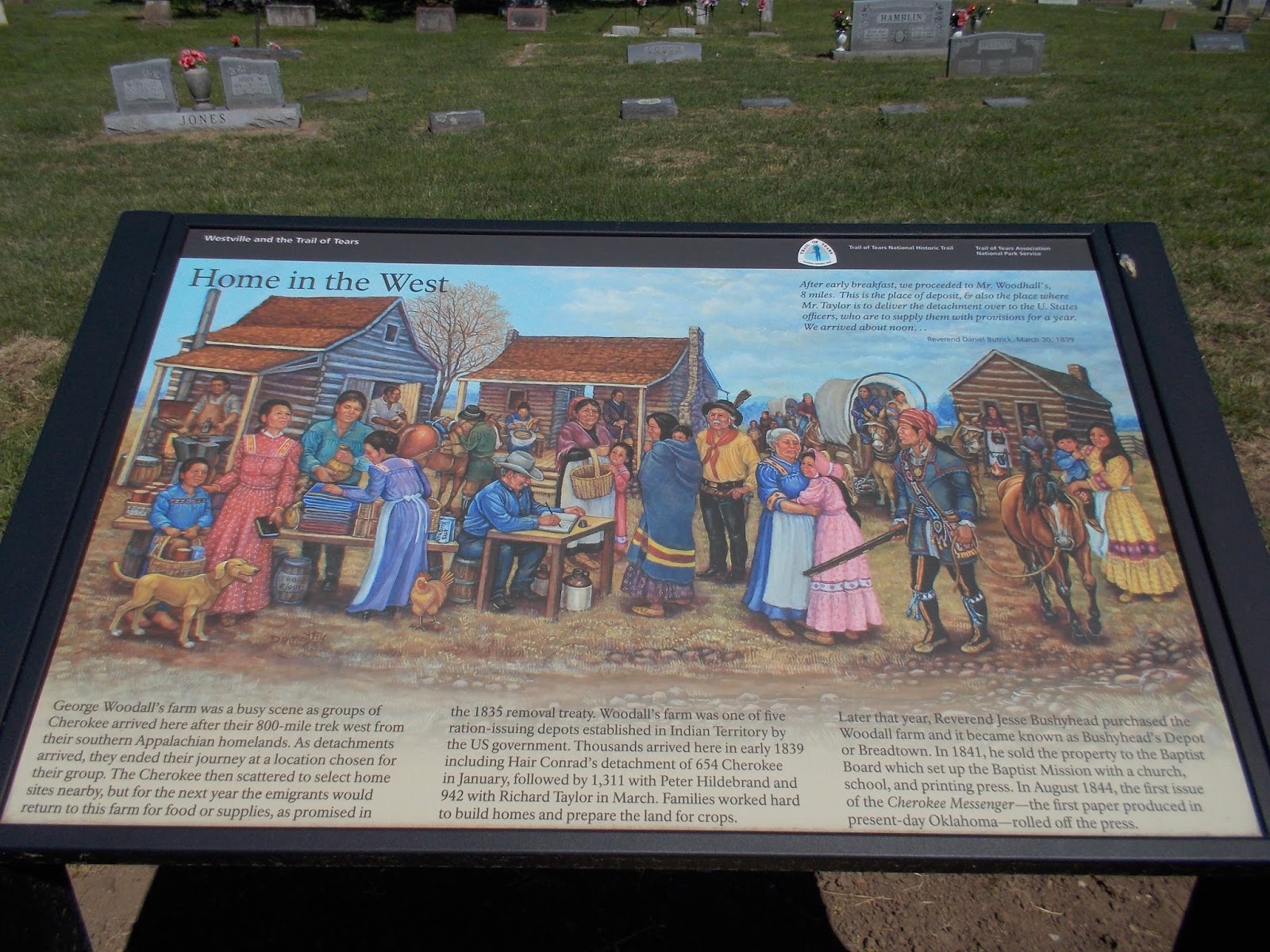
“Baptist Mission. Rev. Jesse Bushyhead settled here in 1839 following the Cherokee removal from the east and held church services at his home until the Baptist Mission was established in 1841 by Rev. Evan Jones. This site was also one of the ration stations known as GA-DU HO-GA-DU or Breadtown by the Cherokee’s following removal. A Cherokee National school was founded near here in 1843 and the mission established a female seminary the same year. The Cherokee Messenger printed here beginning in August 1844, was the first periodical in Oklahoma. The mission station was burned during the Civil War by the Confederates because of the anit-slavery teaching of the missionaries. While the mission was never rebuilt the church has continued to meet. The present church building was built in 1888”

MARKER PLACED BY:  Oklahoma Historical Society

PERSONAL REFLECTIONS: 

US-59 divides the Church from its graveyard. Dana and I spent some time on the cemetery side of the street. It wasn’t until I started doing research that I see we should have spent more than a glance on the church side of the street.

This church has served the Cherokee people for more than just their spiritual needs.
The congregation was originally organized in 1817 in Georgia. It was the only church holding Christian services totally in the Cherokee tongue.

The group moved together, with Rev. Jesse Bushyhead, seen at left, leading, as part of the “Trail of Tears” and legend has it they carried with them wood from their Church in Georgia and it was used to build the first church in Oklahoma.

Although we didn’t see it, a longtime resident in the 1970’s said part of the sandstone foundation of that first church was nearby and said she had heard there is a “lost” cemetery between the first and present church although there is no sign of graves.

I’m not so sure about the “lost” cemetery as it is well documented who settled here and where they are all buried.

The church was nicknamed “Breadtown” by the Cherokee because it was a place they would get their rations from the US Government for a time after they arrived.

Rev Bushyhead was well respected among all Cherokees. Twice a year the Church would hold camp meetings. In the summer, the meetings could last two to three weeks and were attended by people from all over the Cherokee Nation.

A school and a female seminary for the Cherokee was built here in 1843.

Rev. Bushyhead led the congregation until his death in 1844.

Rev. Evan Jones kept the mission going until the start of the Civil War.

Rev. Jones’ son joined him upon graduation from college in 1844 and ran a printing press. “The Cherokee Messenger” was printed here…the first periodical in Oklahoma printed in part English and part in Cherokee.

The Jones’ weren’t in favor in the South because of their anti-slavery teachings and had to leave once the Civil War started. They immediately returned once the war was over.

While they were gone, the mission, printing press and several other buildings were destroyed…burned to the ground by the Confederacy.

Rebuilding was a priority and the Church along with a school and a female seminary was built.

Rev. Jones died in 1873 but his mission work was continued by his son until he passed in 1876.

One of the teachers at the Mission school, Bill Hastings, taught from 1884 to 1886 and then 1889 to 1891. He would go on to become the Attorney General and then the National Attorney for the Cherokee Tribe. He served as a representative in the U.S. Congress from 1915 to 1921 when he became the very first incumbent to be defeated by a female candidate.
Jesse Raper. Born Mar 10, 1797. Died Dec 1887 (This headstone didnt seem to have any historical significance, but it did seem to be the person born the earliest)

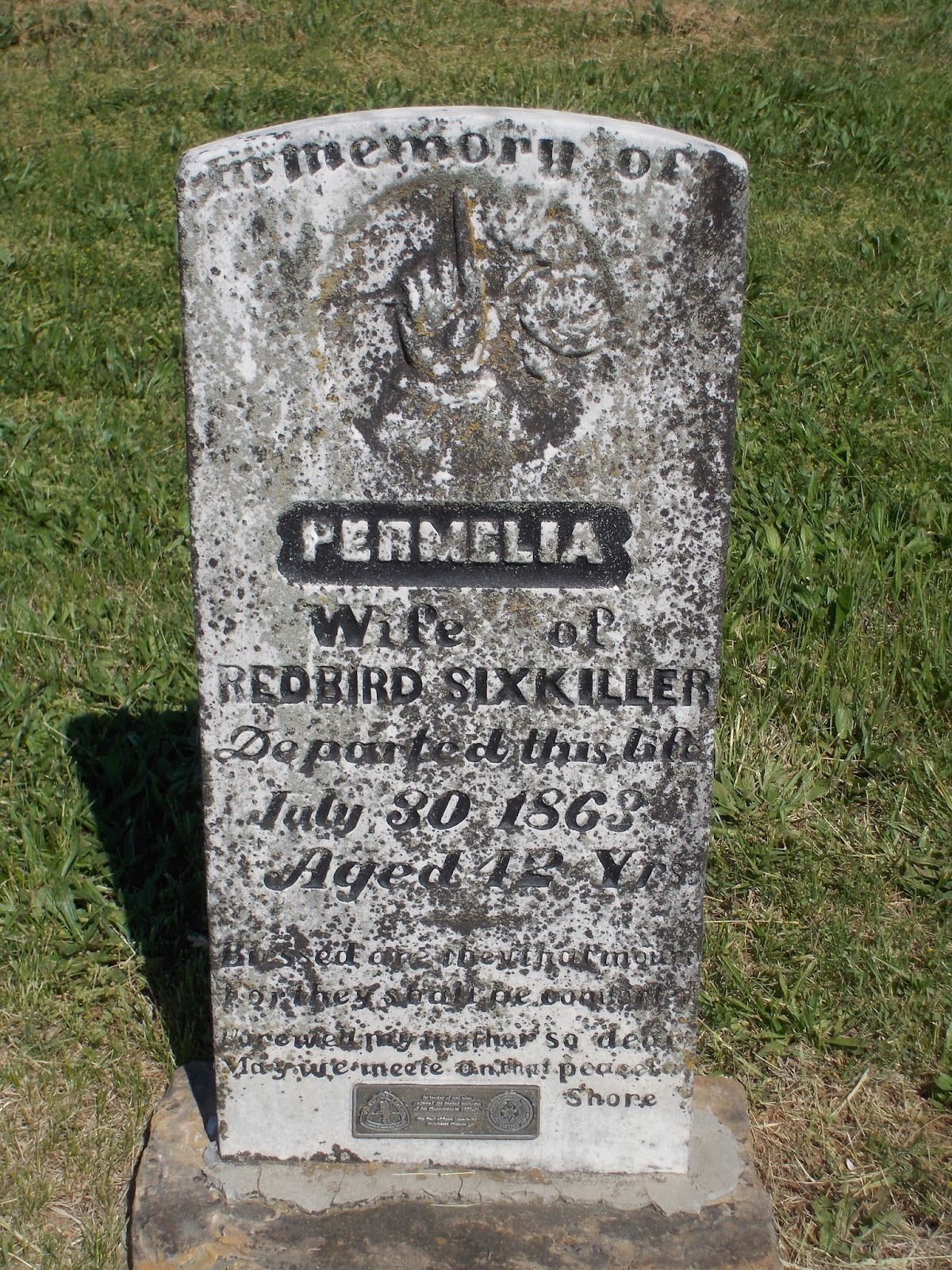
“In memory of Permelia. Wife of Redbird Sixkiller. Departed this life July 30, 1863. Aged 42 yrs. Blessed are they that mourn, for they shall be comforted. Farewell my Mother so dear, may we meet on the peaceful shore”

"Sacred to the memory of Rev. Jesse Bushyhead, born in the old Cherokee Nation in East Tennessee, September, 1804; died in the present Cherokee Nation, July 17, 1844. 'Well done, thou good and faithful servant; thou hast been faithful over a few things, I will make thee ruler over many things. Enter thou into the joy of thy Lord.'" An inscription in Cherokee is at the bottom. On the other side is the inscription:
"Rev. Jesse Bushyhead was a man noble in person and noble in heart. His choice was to be a true and faithful minister of his Lord and Master rather than any high and wordly position. He loved his country and people, serving them from time to time in many important offices and missions. He united with the Baptist Church in his early manhood and died as he had lived, a devoted Christian."

Friday, June 19, 2015

Robert Rogers - Westville, Oklahoma


DATE VISITED:  05/01/2015

HISTORICAL SITE:  Robert Rogers
  
LOCATION:  US 59, Westville, Adair Co., Oklahoma

MARKER #:  64-1995

“Robert Rogers. A signer of the treaty of New Echota and Grandfather of famed Will Rogers. Robert Rogers moved with his wife, Sally Vann, to Indian Territory about 1837, and established a home about 1 mile NW. He was killed in 1842, in a tribal feud as were many of the treaty signers following the forced removal of the Cherokees in 1838-39. He is buried near his home site about ½ mile north and ¾ miles west of here. His widow later married a Virginian, William Musgrove”

Note: “here” is the Baptist Mission Cemetery at US-59, Westville, Oklahoma

MARKER PLACED BY:  Oklahoma Historical Society

PERSONAL REFLECTIONS: 

In 1835, before the Trail of Tears march, a group of Cherokees signed an agreement (The Treaty of New Echota) with the U.S. government to give up all lands east of the Mississippi in exchange for $5 million dollars and lands in what would become Oklahoma.

Some Cherokees, including Robert Rogers, quietly moved to Oklahoma. They are called the “old settlers”.

Many Cherokees, including Chief John Ross, denounced and defied the treaty.

Finally, in 1839, the U.S. Army rounded up the Indians and forced them to walk, in winter, to new homeland in Oklahoma…this is the “Trail of Tears”.

I wonder…if it hadn’t been for the fact that Robert Rogers was the Grandfather to Will Roger, would we really know him as anything more than a signer of the Treaty of New Echota?

Interestingly, I came upon some disagreement whether it is THIS Robert Rogers who truly signed the treaty. It’s said that if it had been him, he would have been about 20 at the time and a Dr. Robert Rogers in Georgia put it in his will that HE was the one who had signed the treaty.

The Cherokees, to this day, believe it was the Robert Rogers I am writing about and apparently so does the Oklahoma Historical Society since they put in on the landmark…a mystery!

Robert, along with his wife Sally, prospered in the new land and it was conspicuous among the Cherokee. They had two children, a boy and a girl.

In 1842, some full blooded Cherokees crept up on Robert and shot him. The lives of several other signers of the treaty also ended in assassination/murder.

A shame, if this wasn’t the Robert Rogers who signed the treaty, then the murder was a horrible mistake.
 
Their home, along with a small family cemetery was a couple of miles north of the mission church.

Thursday, June 18, 2015

Fort Wayne – Watts, Oklahoma


DATE VISITED:  05/01/2015

HISTORICAL SITE:  Fort Wayne

LOCATION:  U.S. Highway 59, just north of Watts, Adair Co., Oklahoma

MARKER #:  65-1995

 DEDICATED:   
“Fort Wayne established in 1838 by Lt. Col. R.B. Mason, 1st Dragoons, U.S. Army, at request of Arkansas citizens fearing Cherokees who were being removed from southeastern U.S. Named in honor of Gen. Mad Anthony Wayne, the fort was originally located in the NE corner of present-day Watts on a hill overlooking Illinois River. Considered poor location because many soldiers died there, including Capt. John Stuart, 7th Infantry. In 1839, fort was abandoned and moved to Beatie’s Prairie, west of Maysville, Arkansas. That site abandoned in 1842 and troops moved north to establish Fort Scott, Kansas”

**closer look below

PERSONAL REFLECTIONS: 

Driving down the highway I see this historical marker coming up and I quickly pulled to the side of the road. I wish I had done more of this on our way out here but I was unsure how long everything would take and my relatives in Arkansas were expecting us at a certain time.

My photographer…Dana…took the picture and we were on our way again. It’s funny, in the Sacramento area and to a lesser degree, in California as a whole, I may not know the history behind a lot of the landmarks but they are familiar on some level. We get out of my home area and I don’t have the faintest idea why something would be determined historical.

There were two “Fort Wayne’s” built. The fort established in 1838 was the second “Fort Wayne”, the first being built by Capt John Stuart of the 7th Infantry.

Mason was ordered to move the Fort from the south bank of the Illinois River headwaters to Spavinaw Creek in Indian Territory.

While it was built to relieve the fear by the residents of northwestern Arkansas that the Cherokee’s were settling in the area, it was mainly built to protect a military road and became a link in Forts built to protect the “new” American West.

The 2nd Fort was abandoned in 1842 because the large number of soldiers coming down with malaria and in an ironic twist…was handed over to the Cherokee Nation, the very people it was built to offer protection from.

 When the Civil War started, the Cherokee leader Stand Watie took over the site and formed the Cherokee Mounted Rifles, part of the Confederacy. In 1862, the Union met the Confederates for the Battle of Old Fort Wayne and in a surprise attack, forced the Confederate Forces to retreat almost 70 miles, leaving behind most of their artillery and capturing Col. Stand Watie.


I read that until the landmark was put up most residents of the area didn’t know that Fort Wayne had even existed. It’s good that someone did because it would be a shame to lose this history and I’m really glad that we took a couple of minutes to grab a picture.