DATE VISITED: 04/28/2015
SITE: American International Rattlesnake Museum
LOCATION: 202 San Felipe St. NW, Albuquerque, Bernalillo Co., New
Mexico
PERSONAL
REFLECTIONS:
Snakes have always held a strange fascination for me. It’s one
of those things where I’m scared but also so interested I normally will go out
of my way to see them. While I love the reptile house at zoos, it’s not like I
want to walk into a room to face a snake.
When Daniel appeared to become allergic to pet dander, we had
to consider other “pets” and a snake was the easy choice. We ended up with a
Corn Snake. When we got it, I had told the pet store I didn’t want anything
that would grow taller than me. At last check “Nake” was about 3 inches taller
than me.
I remember when a name was being considered. David wanted the
name “Viper” and as I wandered through the room, I said the snake would probably
end up being called “Nake” because Danny couldn’t really say his “S’s” yet. And
sure enough…the name stuck.
 This picture doesn't do justice but Nake grew to be a beautiful orange. If you’ve never touched a
snake, you might be surprised to find they are incredibly soft. I love touching
Nake…as long as someone is facing his head away from me. I’ve seen him bite the
hand…and tummy…of the one that feeds him. Comical as it was listening to the “ouch,
ouch, ouch”…I certainly never want to experience it myself.
This picture doesn't do justice but Nake grew to be a beautiful orange. If you’ve never touched a
snake, you might be surprised to find they are incredibly soft. I love touching
Nake…as long as someone is facing his head away from me. I’ve seen him bite the
hand…and tummy…of the one that feeds him. Comical as it was listening to the “ouch,
ouch, ouch”…I certainly never want to experience it myself.
I was quite excited to go to the National Rattlesnake Museum
which was the opposite of Dana although she definitely warmed up to the place
and was even sending SnapChats to her family.
The museum claims to have more live rattlesnakes, combined,
than 6 of the largest zoos in the U.S. and have 30 or so out of the 100 on
exhibit at all times with a plan on expanding soon.
The entrance fee of $5.00 is well worth what you will see
during your visit. Their front area, with gift shop, doesn’t give you a clue as
to how extensive the collection and exhibits are.
Rattlesnakes are native to the Americas with a majority of the
species living in the American Southwest and Mexico while four are found east
of the Mississippi and two in South America
It is believed that the ancestral area for the rattlesnake is
probably in the Sierra Madre Occidental area of Mexico, a mountainous area in
western Mexico.
While many snakes and other reptiles are oviparous (lays eggs),
the rattlesnake is ovoviviparous (gives birth to live young after carrying eggs
inside).
We all know that snakes can hibernate but I found out they can
also “aestivate”. Hibernation is basically
going dormant if the temperature gets too cold. Aestivation is the opposite…going
dormant when the temperature is too hot.
Humans experience about 8,000 bites from venomous snakes and rattlesnakes
are the leading cause of snakebite injuries in North America. That being said, less
than 1% result in death.
Antivenom is developed by “milking” rattlesnakes and injecting
the venom into horses, sheep or goats who naturally produce antibodies. The red
blood cells are separated and the serum is made into a powder to be used later by humans. Because it comes from animal antibodies, humans generally display an
allergic reaction during the infusion.
While their museum is devoted mainly to rattlesnakes, they did
have a couple of other interesting residents…
I had never seen anything like this…an
alligator snapping turtle but but when I started asking around, lots of people
grew up with them.
They are mainly in the Southeastern U.S. but
can also be found in Kansas, Indiana, Missouri, Iowa, Kentucky and as far north
as South Dakota. All I know is that I never want to run into one.
They will eat just about anything they can
get their mouths on. When younger, they tend to hang around on the bottom with
their mouths hanging open and their tongues hanging loosly…their tongues look
like little worms and so entice fish to come closer.
They can bite hard enough to amputate fingers
and after being found in the Czech Republic and Germany, are on the EU’s list
of invasive species.
Some of their reptiles have names, like “Mollie”,
the resident Gila Monster.
Gila Monsters are only 1 of 2 venomous
lizards in the entire world and these are native to the Southwestern U.S. and
the Mexican state of Sonora
The Apache and Pima believed Gila Monsters could
kill or cause sickness while the Seri and Yaqui believed the skin had healing
properties.
But one undisputed fact is that they are so
slow, they are rarely dangerous to humans. In fact, a Dr. Ward wrote in 1899
that “I have never been called to attend a case of Gila Monster bite and I don’t
want to be. I think a man fool enough to get bitten by a Gila Monster ought to
die. The creature is so sluggish and slow of movement that the victim of its
bite is compelled to help largely in order to get bitten”
“Marilyn” is an albino Western Diamond Back Rattlesnake.
Albino’s normally don’t last long in the wild as they definitely stand out and
easily become prey.
A normal colored Western Diamond Back
Rattlesnake
 A Paniment
Speckled Rattlesnake that calls Nevada & California home.
A Paniment
Speckled Rattlesnake that calls Nevada & California home.
I wish they showed this snake on their website as I would love
to know exactly what it was. What I do remember was that it is definitely not
an albino.
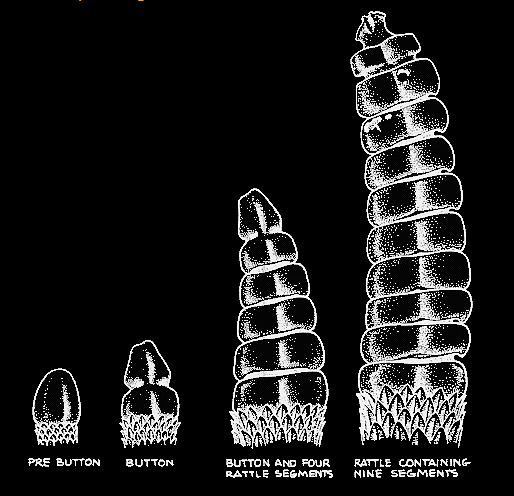
 Rattlesnakes are born with a tail called “pre-button” but
within 7 days of birth they have their first shedding and then it becomes the “button”.
After that, each shedding, will add another “rattle”. The noise (listen here) is made when
one rattle vibrates against another.
Rattlesnakes are born with a tail called “pre-button” but
within 7 days of birth they have their first shedding and then it becomes the “button”.
After that, each shedding, will add another “rattle”. The noise (listen here) is made when
one rattle vibrates against another.
Dana and I were given “certificates of bravery” for completing
a tour of the museum. It was very interesting and well work the visit.
 LOCATION: Thoreau, McKinley Co., New Mexico
 The Divide extends from the Bering Straight to the Strait of
Magellan, on the tip of South America. Although there are other Divides in the
America's, the "Great Divide" is the one that follows the line of
high peaks along the Rockies and Andes.
The Divide extends from the Bering Straight to the Strait of
Magellan, on the tip of South America. Although there are other Divides in the
America's, the "Great Divide" is the one that follows the line of
high peaks along the Rockies and Andes.