DATE VISITED: 05/02/2015
HISTORICAL
SITE: Prairie Grove Civil
War Battlefield
Dedicated to the Soldiers of 1861-1865…1917-1918
Erected by the Daughters of Confederacy 1924
LOCATION: 506 E. Douglas St., Prairie Grove, Washington
Co., Arkansas
MARKER #:
70000133 (original) - 92001523 & 05001167 (boundary
increases)
DEDICATED: September 4, 1970 with boundary increases on
November 9, 1992 and October 27, 2005
“This property has been placed on the
National Register Of Historic Places by the United States Department of Interior”
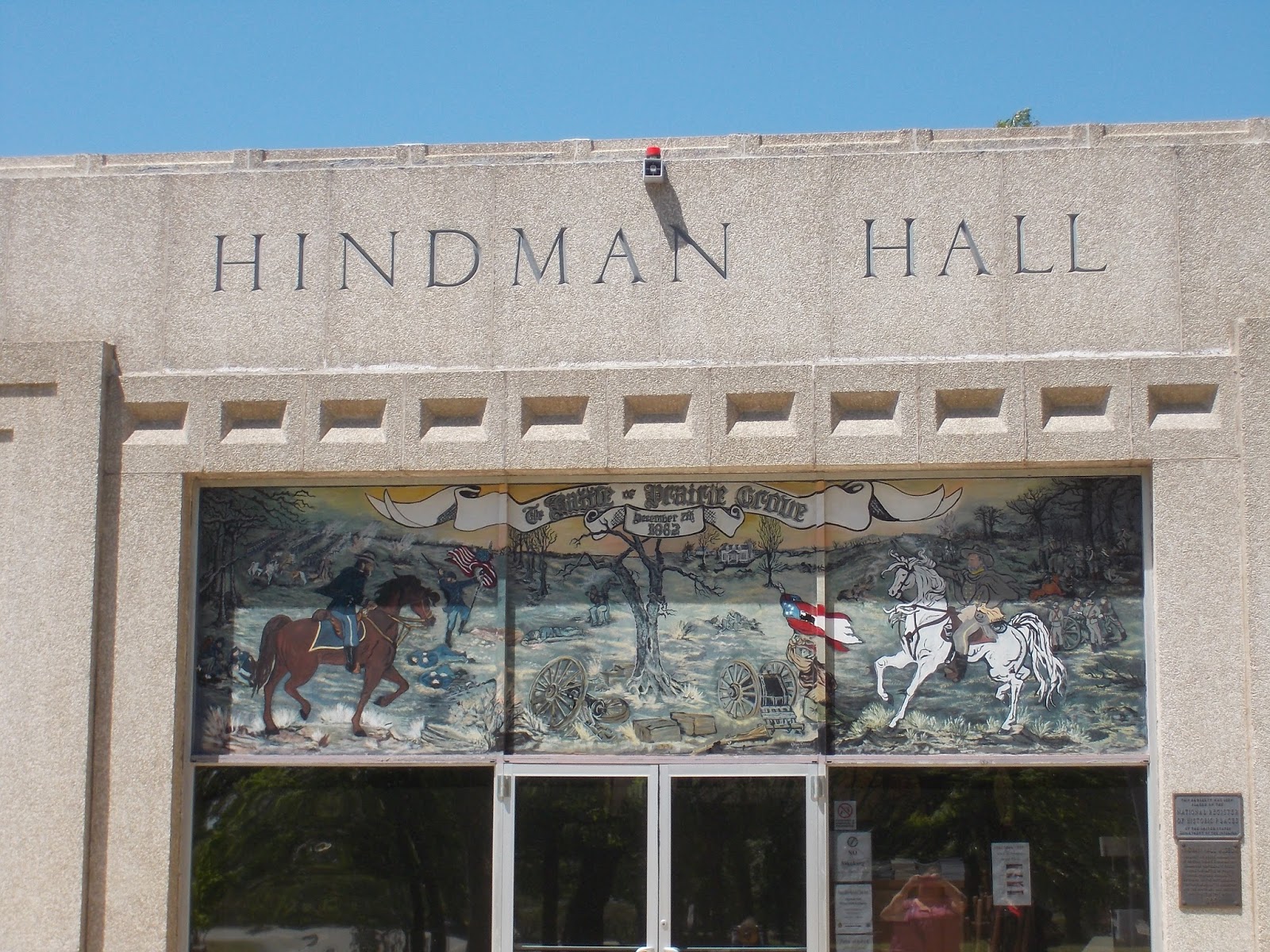
Hindman Hall Museum A bequest by Biscoe, son of General Thomas
C. Hindman who commanded Confederate forcces during the Battle of Prairie Grove, provided $100,000 to establish on the battlefield a “suitable memorial”
to his Father and the brave men and officers who fought in that battle. 1965
MARKER
PLACED BY: United States
Department of the Interior
PERSONAL
REFLECTIONS:
I have always wanted to go to a Civil War battlefield but
living in California makes it difficult without a long trip. Lucky for us…this
trip took us right into the vicinity of a battlefield that is known for being
most the intact in the U.S.
I have always found the Civil War to be a fascinating period
in U.S. history. My boys have the unique position of their ancestors being on
both sides. All of their maternal ancestors fought for the Confederacy while
their paternal side of the family fought only for the Union.
In fact, I have been working on the family genealogy since
David had to do a family history assignment in the 4th grade.
Helping David gave me the bug and I’ve done research off and on for the past 20
years. I found one area in southern Indiana/northern Kentucky where a Conner
(paternal) fought and lost an arm in the same general area where a Beaver
(maternal) was also fighting. At this point, I can’t say whether they were even
in the same battle…just an interesting thought to ponder.
 |
| Museum |
So, it was with much excitement that Dana and I visited the
Prairie Grove Battlefield. It is a sprawling 270 acres with a museum, a walking
tour and a driving tour. We spent some time in the museum before heading out.
 |
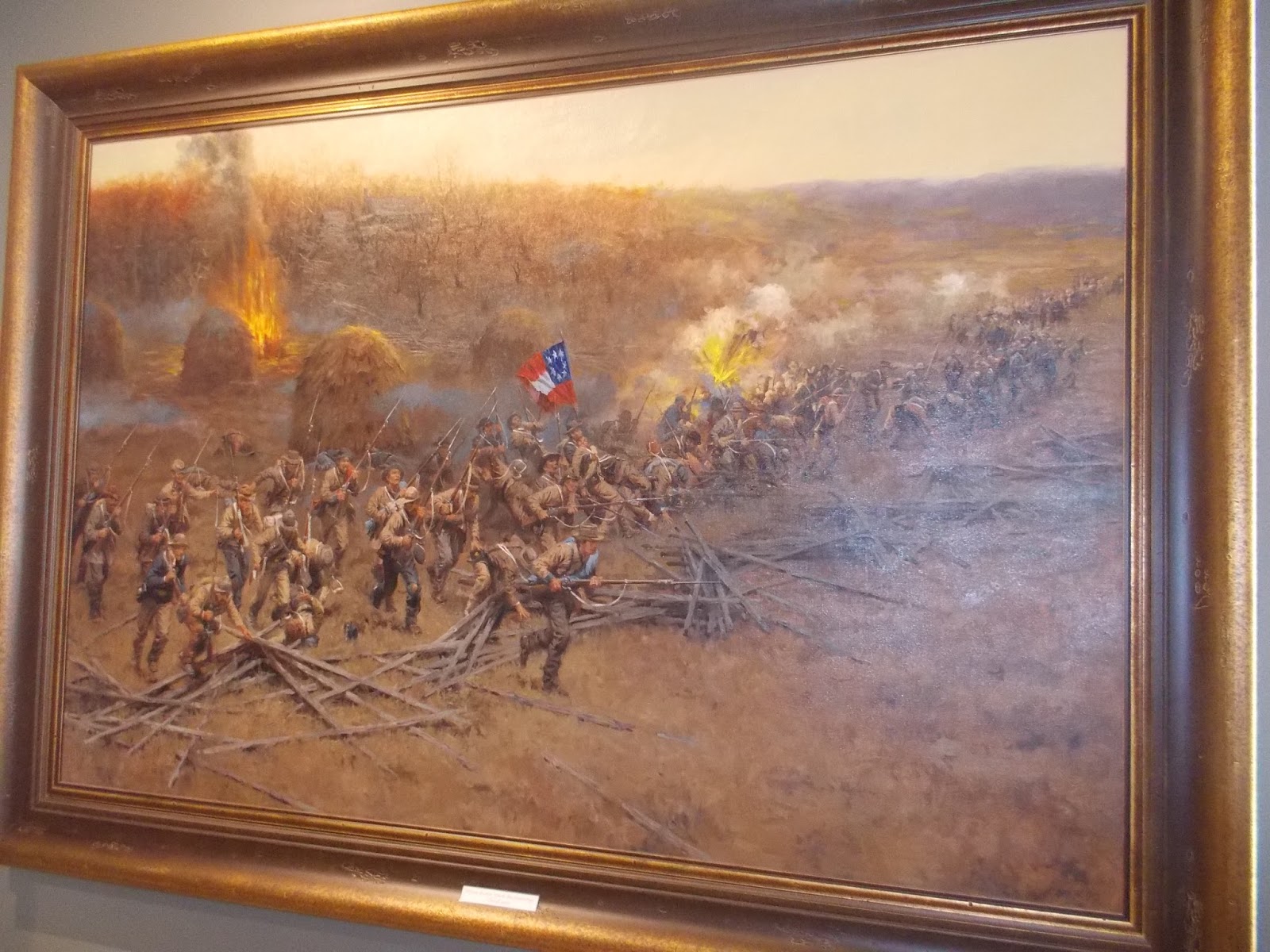
| "The Bayonet Or Retreat" |
 |
| "They Came Like Demons" |
 |
| Field Surgeon's Kit |
 |
| Confederate Money |
 |
| Cannonballs |
 |
| The Blue & The Grey |
The day was humid so it didn’t take long for these poor girls
from California to wilt and we quickly decided upon the driving tour.
Although what follows will be several markers, what I found in
retrospect is that there is a lot of redundancy.
Bottom line…Confederate General
Hindman knew that two Union Divisions had been separated by too much distance.
Hindman knew if he could defeat these two Divisions, he would retake northwest
Arkansas for the Confederacy and open up the possibility of an invasion of
Missouri. In the end, the battle was a stalemate but because of lack of
supplies, and once the two Union Divisions were combined, the Confederate army
retreated to Van Buren Arkansas and any thoughts of a Missouri invasion, was
lost.
 Battlefield Park The original 10 acres of Battlefield Park
were purchased in 1908 by the Prairie Grove chapter of the United Daughters of the
Confederacy and maintained by the U.D.C. for nearly 50 years as a memorial
park. From 1886 to 1926 an annual reunion of Confederate veterans was held on
this site. The State of Arkansas in 1957 created a Prairie Grove Battlefield Commission which added 55 acres to the Park area and developed the Park as a
battle memorial. Members of the first Commission, appointed by Governor Orval
E. Faubus, were Fred McCuistion, Mrs. J.C. Parks, Mrs. Lee Seamster, Glenn Will
and W.J. Lemke.
Battlefield Park The original 10 acres of Battlefield Park
were purchased in 1908 by the Prairie Grove chapter of the United Daughters of the
Confederacy and maintained by the U.D.C. for nearly 50 years as a memorial
park. From 1886 to 1926 an annual reunion of Confederate veterans was held on
this site. The State of Arkansas in 1957 created a Prairie Grove Battlefield Commission which added 55 acres to the Park area and developed the Park as a
battle memorial. Members of the first Commission, appointed by Governor Orval
E. Faubus, were Fred McCuistion, Mrs. J.C. Parks, Mrs. Lee Seamster, Glenn Will
and W.J. Lemke.
 March of the Armies December 3-7, 1862 General Hindman on the Arkansas River planned
to drive General Blunt’s Federal army out of nothwest Arkansas. The Confederate
army left Van Buren on December 3. Enroute north, Hindman learned that Blunt
had called for help from General Herron at Wilson’s Creek, MO and that the
latter was already on the march. Hindeman decided to bypass Blunt at Cane Hill
and march to intercept Herron. Herron’s army made a forced march of 100 miles
in 3 days ran into the Confederate advance early on the morning of Sunday,
December 7. The Confederates established themselves on this ridge, facing
northeast. Herron crossed the Ilinois River and attacked. Meanwhile Blunt at
Cane Hill learned that the Confederate army had bypassed him, so he marched his
army to Rhea’s Mill, the approached the battle from the northwest, arriving on
the field at 2:00pm. Darkness finally halted the bitteryly-fought battle.
During the night, Hindman’s army, low on supplies and ammunition, withdrew
south to Van Buren.
March of the Armies December 3-7, 1862 General Hindman on the Arkansas River planned
to drive General Blunt’s Federal army out of nothwest Arkansas. The Confederate
army left Van Buren on December 3. Enroute north, Hindman learned that Blunt
had called for help from General Herron at Wilson’s Creek, MO and that the
latter was already on the march. Hindeman decided to bypass Blunt at Cane Hill
and march to intercept Herron. Herron’s army made a forced march of 100 miles
in 3 days ran into the Confederate advance early on the morning of Sunday,
December 7. The Confederates established themselves on this ridge, facing
northeast. Herron crossed the Ilinois River and attacked. Meanwhile Blunt at
Cane Hill learned that the Confederate army had bypassed him, so he marched his
army to Rhea’s Mill, the approached the battle from the northwest, arriving on
the field at 2:00pm. Darkness finally halted the bitteryly-fought battle.
During the night, Hindman’s army, low on supplies and ammunition, withdrew
south to Van Buren.
Battle of Prairie Grove December 7, 1862 The battle on this field was between the
Confedate army of General T.C. Hindman (Arkansas) and Federal forces commanded
by Generals James C. Blunt (Kansas) and F.J. Herron (Iowa). Battlefield Park
occupies the approximate center of the Confederate position. From 10am to 2pm
the contest was between Herron, attacking from the north and the Confederate
defenders of this ridge. From 2 o’clock until dark, the battle was chiefly
against Blunt’s army, attacking from the northwest. Hindman reported that he
had 11,000 troops engaged. Blunt’s report gives his force as 8,000 and Herron’s
as 5,000. The Confederate loss in killed, wounded and missing was 1,317. The
Federal loss was 1,148. During the night of December 7-8 the Confederate army
withdrew to Van Buren.
 Commerating valor, sacrifice and fortitude of
the youth of Arkansas 1861-in the Confederacy-1865 Dedicated by the Children of the Confederacy
Arkansas Division September 2, 1937
Commerating valor, sacrifice and fortitude of
the youth of Arkansas 1861-in the Confederacy-1865 Dedicated by the Children of the Confederacy
Arkansas Division September 2, 1937
 Blunt’s attack From this spot the observer is viewing the
terrain over which General James C. Blunt’s 1st Division advanced on
the afternoon of December 7, 1862, to attack the Confederate left and relive
the pressure on General F.J. Herron’s 2nd and 3rd
Divsions which had been engaged since early morning. Blunt had been camp at
Cane Hill and was bypassed by General T.C. Hindman’s army on the night of
December 6. Blunt marched his men to Rhea’s Mill on Sunday morning, December 7,
and entered the battle here at 2
o’clock in the afternoon.
Blunt’s attack From this spot the observer is viewing the
terrain over which General James C. Blunt’s 1st Division advanced on
the afternoon of December 7, 1862, to attack the Confederate left and relive
the pressure on General F.J. Herron’s 2nd and 3rd
Divsions which had been engaged since early morning. Blunt had been camp at
Cane Hill and was bypassed by General T.C. Hindman’s army on the night of
December 6. Blunt marched his men to Rhea’s Mill on Sunday morning, December 7,
and entered the battle here at 2
o’clock in the afternoon.
 Battle Monument Rhea’s
Mill This tower was the chimney of
Rhea’s Mill, which stood 6 miles northwest of this spot. The mill was operated
by the Federal army before and after the Battle of Prairie Grove. General
Blunt’s supply train was at Rhea’s during the battle, under guard of General
Frederick Salomon’s troops.
Battle Monument Rhea’s
Mill This tower was the chimney of
Rhea’s Mill, which stood 6 miles northwest of this spot. The mill was operated
by the Federal army before and after the Battle of Prairie Grove. General
Blunt’s supply train was at Rhea’s during the battle, under guard of General
Frederick Salomon’s troops.
The tower is 55 feet high and weighs 200,000 pounds. It is 8
feet square at the base and tapers to 4 by 4 feet at the top. It contains 700
stones. The chimney was taken down at Rhea’s and re-erected here as a memorial
to the men who fought on this field December 7, 1862.
This tower was given to Battlefield Park in
1957 by Mr. and Mrs. G.C. Mennecke.
 Major General Thomas C. Hindman Thomas C. Hindman commanded the Confederate
army in the battle of Prairie Grove. He was born in 1828 in Tennessee. Served
in the war with Mexico, later moving from Mississippi to Helena, Ark. Was
elected to Congress in 1859. In 1861, he entered the Confederate army as
Colonel and won promotion to Major General at the Battle of Shiloh. Transferred
to the Trans-Mississippi Department, he raised the army that fought at Prairie
Grove. He later fought in many battles in Tennessee, Georgia and North
Carolina.
Major General Thomas C. Hindman Thomas C. Hindman commanded the Confederate
army in the battle of Prairie Grove. He was born in 1828 in Tennessee. Served
in the war with Mexico, later moving from Mississippi to Helena, Ark. Was
elected to Congress in 1859. In 1861, he entered the Confederate army as
Colonel and won promotion to Major General at the Battle of Shiloh. Transferred
to the Trans-Mississippi Department, he raised the army that fought at Prairie
Grove. He later fought in many battles in Tennessee, Georgia and North
Carolina.
 General James G. Blunt Genearal Blunt of Kansas commanded the First
Division of the Federal army in the Battle of Prairie Grove. He was made
Brigadier General in April 1862 and given command of the all Kansas troops. His
army was at Cane Hill December 6, 1862 but reached this field at 2pm on
December 7, to relieve General Herron’s army.
General James G. Blunt Genearal Blunt of Kansas commanded the First
Division of the Federal army in the Battle of Prairie Grove. He was made
Brigadier General in April 1862 and given command of the all Kansas troops. His
army was at Cane Hill December 6, 1862 but reached this field at 2pm on
December 7, to relieve General Herron’s army.
General Francis J. Herron General Herron of Iowa, in command of the 2nd
and 3rd Divisions of the Federal army, was encamped at Wilson’s
Creek, MO., when Blunt summonded him to Cane Hill. A forced march of 100 miles
in 3 days brought Herron’s army to Prairie Grove early on the morning of
December 7, 1862. His army bore the brunt of the battle until relieved by
Blunt.

 This house, built about 1855, was the home of
the John Morrow family, and originally stood on Cove Creek 9 miles south of
here. On the night before the battle of Prairie Grove, Confederate General T.C.
Hindman met with his division and brigade commanders in this house and made
final plans for battle. The army left the Morrow farm for Prairie Grove at 4
o'clock on the morning of December 7, 1862. This house also sheltered General
Sterling Price in February 1862 when Price's army was enroute to the battle of
Pea Ridge.
This house, built about 1855, was the home of
the John Morrow family, and originally stood on Cove Creek 9 miles south of
here. On the night before the battle of Prairie Grove, Confederate General T.C.
Hindman met with his division and brigade commanders in this house and made
final plans for battle. The army left the Morrow farm for Prairie Grove at 4
o'clock on the morning of December 7, 1862. This house also sheltered General
Sterling Price in February 1862 when Price's army was enroute to the battle of
Pea Ridge.
 The Lord’s Vineyard This 2-story log house and out-buildings were
erected by John Latta about 1834 on Evansville Creek, 12 miles southwest of
this spot. The Latta settlement was called Vineyard from “The Lord’s Vineyard”.
The Vineyard was the first postoffice in Washington County (1829). John Latta
was postmaster from 1835 to 1838 and conducted the office in this house. It was
also a stop on the early stage route from Fayetteville and Cane Hill to Van
Buren. This house figured in many of the stirring events of pioneer days on the
Indian border. The buildings were given to the Washington County Historical
Society by F.F. Latta, grandson of the pioneer builder, and were removed to
this site in 1958.
The Lord’s Vineyard This 2-story log house and out-buildings were
erected by John Latta about 1834 on Evansville Creek, 12 miles southwest of
this spot. The Latta settlement was called Vineyard from “The Lord’s Vineyard”.
The Vineyard was the first postoffice in Washington County (1829). John Latta
was postmaster from 1835 to 1838 and conducted the office in this house. It was
also a stop on the early stage route from Fayetteville and Cane Hill to Van
Buren. This house figured in many of the stirring events of pioneer days on the
Indian border. The buildings were given to the Washington County Historical
Society by F.F. Latta, grandson of the pioneer builder, and were removed to
this site in 1958.

 The Borden House The
Borden House was the epicenter of what one historian has called “one of the
most intense firefights west of the Mississippi” during Dec. 7, 1862, Battle of
Prairie Grove. Union and Confederate troops fought around the house and
orchard, suffering hundreds of casualties. The Borden family sought refuge from
the fighting with other families in the cellar one mile west of here. The day
after the battle the Borden family returned to find that their home had been
burned to the ground. The house here now was built on the same site around
1870.
The Borden House The
Borden House was the epicenter of what one historian has called “one of the
most intense firefights west of the Mississippi” during Dec. 7, 1862, Battle of
Prairie Grove. Union and Confederate troops fought around the house and
orchard, suffering hundreds of casualties. The Borden family sought refuge from
the fighting with other families in the cellar one mile west of here. The day
after the battle the Borden family returned to find that their home had been
burned to the ground. The house here now was built on the same site around
1870.
Friends of the Prairie Grove Battlefield, Inc.
No. 19 2011
 Herron’s Attack From this spot the observer is viewing the
fields over which General F.J. Herron’s army advanced on the morning of
December 7, 1862 to attack the Confederate position on this ridge. Because the
ford of the Illinois River was under artillery fire Herron crossed northwest of
the ford, or almost directly north of this spot. His army consisted of troops
from Missouri, Iowa, Illinois, Wisconsin, Indiana and Arkansas. Herron’s
Divisions bore the brunt of the battle until 2pm when Blunt’s army came to his
aid. Blunt’s army entered the battle one mile west of this spot.
Herron’s Attack From this spot the observer is viewing the
fields over which General F.J. Herron’s army advanced on the morning of
December 7, 1862 to attack the Confederate position on this ridge. Because the
ford of the Illinois River was under artillery fire Herron crossed northwest of
the ford, or almost directly north of this spot. His army consisted of troops
from Missouri, Iowa, Illinois, Wisconsin, Indiana and Arkansas. Herron’s
Divisions bore the brunt of the battle until 2pm when Blunt’s army came to his
aid. Blunt’s army entered the battle one mile west of this spot.
 The Dead of Prairie Grove
The men who died on this field on December 7, 1862 are buried in soldier
cemeteries in Fayetteville. 700 unknown Confederate soldiers are in the
cemetery maintained by the Southern Memorial Association on East Mountain. The
Union dead are in the Fayetteville National Cemetery. The commanding Generals
reported 339 dead and 1,630 wounded in action. The records show that many of
the wounded died—430 in army hospitals of Fayetteville, 150 in churches and
homes of Cane Hill, and others in homes along the Cove Creek and Telegraph
roads. The losses were about 10 per cent of the troops engaged.
The Dead of Prairie Grove
The men who died on this field on December 7, 1862 are buried in soldier
cemeteries in Fayetteville. 700 unknown Confederate soldiers are in the
cemetery maintained by the Southern Memorial Association on East Mountain. The
Union dead are in the Fayetteville National Cemetery. The commanding Generals
reported 339 dead and 1,630 wounded in action. The records show that many of
the wounded died—430 in army hospitals of Fayetteville, 150 in churches and
homes of Cane Hill, and others in homes along the Cove Creek and Telegraph
roads. The losses were about 10 per cent of the troops engaged.
Additional Info...


 You are
first introduced to the National Park at the Visitors Center where there is a
30 minute film with battle re-enactments. The park itself is a 4.9 mile
self-guided tour that has 8 stops in places that are considered significant to
the battle.
You are
first introduced to the National Park at the Visitors Center where there is a
30 minute film with battle re-enactments. The park itself is a 4.9 mile
self-guided tour that has 8 stops in places that are considered significant to
the battle. Missouri
was a state with internal conflict during the Civil War. They elected to stay
in the Union but declared themselves neutral and stated they would not send
supplies or men to either Army. There were plenty of slave owners in Missouri and
the government was often found to be harassing the Union Army. At one point,
the Union demanded free rein through Missouri while the Governor said they must
stay in the St. Louis area.
Missouri
was a state with internal conflict during the Civil War. They elected to stay
in the Union but declared themselves neutral and stated they would not send
supplies or men to either Army. There were plenty of slave owners in Missouri and
the government was often found to be harassing the Union Army. At one point,
the Union demanded free rein through Missouri while the Governor said they must
stay in the St. Louis area.


 Unfortunately,
or fortunately, depending upon your choice of sides, the Confederate army was
too disorganized and ill equipped to go after the Union army and it was this failure
of the Confederates to exploit their victory here that probably kept Missouri
in the Union.
Unfortunately,
or fortunately, depending upon your choice of sides, the Confederate army was
too disorganized and ill equipped to go after the Union army and it was this failure
of the Confederates to exploit their victory here that probably kept Missouri
in the Union. After
more skirmishes, and being unable to secure Missouri, the Missouri Guard moved
to battles in Arkansas and Mississippi. That didn’t mean Missouri was
quiet...just the opposite. With the organized Armies gone, guerrilla warfare
between the sides kept the conflict going.
After
more skirmishes, and being unable to secure Missouri, the Missouri Guard moved
to battles in Arkansas and Mississippi. That didn’t mean Missouri was
quiet...just the opposite. With the organized Armies gone, guerrilla warfare
between the sides kept the conflict going.