Showing posts with label Chinese. Show all posts

Thursday, July 30, 2015

The Town of Locke - Walnut Grove, California


DATE:  July 12, 2015

HISTORICAL SITE:  The Town Of Locke

LOCATION:  13920 Main St., Walnut Grove, Sacramento Co., CA

MARKER #:  71000174

DEDICATED:  May 6, 1971

"Locke   Founded in 1912, by Tin Sin Chan, on this site. This unique Chinese community grew rapidly after a fire destroyed the Chinese section of Walnut Grove in 1915. At one time, the town had a population of 1,500, with a theater, hotel, school, church, nine grocery stores, six restaurants, a bakery, lodge and post office. The entire town is Chinese architecture and the original buildings are still standing. Locke residents contributed greatly to the development of levees in the Sacramento Delta"

MARKER PLACED BY:  Dedicated by the Sacramento County Historical Society

PERSONAL REFLECTIONS: 

樂居 or 乐居 = Locke

It is said that Locke is the only truly Chinese enclave left in the United States.

When we lived in the town of Hood, we were only 12 miles away from Locke, but go there and it's a total different world, almost a different era.

I took Dirk because Locke had always been a bit of a mysterious place. There were very few inhabitants and it seemed as though the ones there didn't really want to deal with "outsiders".

The few times I was there, I would often catch glimpses of some movement in alleyways between the buildings but when I would stop and really look, no one was there.

So I took Dirk thinking we wouldn't be there very long, but oh boy...Locke has changed!

Open for the public is a renovated lodging house with a museum. The schoolhouse and gambling house have been cleaned up and are open as they were in Locke's heyday.
 
Finally, money has come to the rescue of Locke!

The Swampland Reclamation Act of 1861 was designed to drain swamp areas, build levies and protect the Sacramento area from flooding. Mostly poor Chinese, being paid less than a dollar a day, stood in swampy water, risking malaria, and built hundreds of miles of levees and reclaimed 88,000 acres. Those acres were to become some of the most fertile land in California.


In 1912, three Chinese merchants asked the land owner, George Locke, if they could build on his land. They built a dry goods store/beer hall, a gambling establishment and a hotel/restaurant.

And we had the beginnings of a town. The town was called Lockeport after the owner.
These 3 merchants could have bought the land but this was the time of the "California Alien Land Law" and the Chinese weren't allowed to own any land.

A total of 7 buildings became the town of Lockeport, including a bordello. Although it had been hoped that Lockeport would become a riverboat and train destination, the discrimination against the Chinese was too much to overcome

In 1915, the Chinese area of nearby Walnut Grove burnt to the ground and a lot of the Chinese moved to Lockeport.

Finally, the Chinese found somewhere in the U.S. where they were more or less left alone and could find good steady, although seasonal, work.

The population ebbed and flowed based on the growing and harvest seasons. As many as 1,500 people lived in Locke when there was work in the fields...a migrant population. And the town welcomed them by providing all the lodging, stores and entertainment desired.

During the 1940's and 1950's, the Chinese community, becoming better educated, started moving out of these small towns and into the cities. It was the death to many of these communities, but Locke tried to hold on. Time moves on, the younger people move and the older people pass and Locke was disintegrating before their eyes.

In 1977, a Hong Kong business man bought the town from the heirs of George Locke. The idea was to build a few new houses in the area and to make Locke a tourist destination, of sorts.

They were stymied by the people. People wanted Locke back but not at the cost that was becoming clear. And they were stymied by the fact that the town was on the National Register of Historic Places, which really limits how things can be renovated or improved.

While they tried to get the Chinese to rebuild their buildings, very few were interested in sinking money into the buildings they owned on land that someone else did.
Locke was given the designation of a National Historic Landmark District in 1990.

Discouraged, the Hong Kong business man finally sold the land and town to the Sacramento Housing and Redevelopment Agency and in turn, the land was sold to the people who owned the buildings on top of it.


The modest changes we saw have been brought about by that Agency, along with the people in Locke. There is a small memorial section dedicated to "in the memory of the industrious Chinese pioneers of California whose strength and sacrifice helped build the transcontinental railroad, construct the levees of the Sacramento San Joaquin Delta, and developed agriculture in the Central Valley. With determination and perseverance the Chinese built the town of Locke and continue to shape California".

 
While there are signs of life now, there is plenty of decay left. When Dirk and I got to the end of Main Street, we turned down another area. The road was unpaved and although people still live there, most of the houses were in various stages of falling apart and the smell was unpleasant.


Currently, about 75 people live in Locke. Of those 75, only about 10 are Chinese.

Interesting article written in the 80's about Locke.

Sunday, April 12, 2015

Town of Auburn - Auburn, California


DATE VISITED:  04/04/2015


HISTORICAL SITE:  Town Of Auburn


LOCATION:  Bounded by Maple, Commercial, Washington, Spring & Sacramento Streets, Auburn, Placer Co., CA

MARKER #:  1970000138 (Federal) & 404 (State)
 
DEDICATED:  September 23, 1950


"Gold discovered near here by Claude Chana May 16, 1848. Area first known as "North Fork" or "Wood's Dry Diggings". Settlement given name of Auburn in fall of 1849. Soon became important mining town, trading post and state terminal. County seat of Sutter County 1850 and Placer County 1851. Destroyed by fire 1855, 1859 and 1863.


"Base built and plaque remounted by Lord Sholto Douglas, Chapter No. 3, E Clampus Vitus, September 23, 1982"

**closer look below

MARKER PLACED BY:  Placed by California Centennials
Commission. Base furnished by Placer County Historical Society

PERSONAL REFLECTIONS: At the last minute I asked Dana if she wanted to go with me. For those of you who don’t know, Dana is my sister. Asking Dana at the last moment isn’t the best thing for me. I am not…surprise…a very patient person and my sister needs “sufficient” time to get ready. Those two things…lack of patience and needing “sufficient” time, don’t always go together. This time I asked her knowing I had a couple of tasks to complete so I wasn’t just sitting around waiting. On her part, she got ready pretty darn fast.

This was my second trip to Auburn, the last being a beautiful day after a cold spell and everyone else wanted to be outdoors too. (Well, cold for California. You have to understand, it’s all relative). Last time, the patience factor kicked in and I didn’t stop. Auburn was only slightly less busy but I did find a parking spot…*thank you to the SUV who pulled away from the curb just as I drove up* We parked the car at the top of Sacramento Street and started our walk down to the main part of downtown Auburn. This is no little downhill and while not a problem, all I kept thinking was…dang, I’m going to have to walk up this later. I told Dana a number of times “watch your feet”…”watch your feet”…”watch your feet” and started to laugh. This was what Dirk had to go through we visited Sutter Creek, Murphy’s and Sonora. I like it a lot better when I’m the one looking around and someone else is watching MY feet and catching ME as I trip.

We quickly found out what had drawn so many people to Auburn other than just the nice weather and the fact rain was in the forecast for Easter Sunday. Many of the shops had balloons in front and there were kids all over the place. It was Auburn’s Easter Egg Hunt event. Yippee us!

Both Dana and I were hungry but every place we passed had lots of people waiting to be seated. We saw a sign for the Brookside Grill and wandered to the back of a little shopping area. The place is charming, had really good burgers and best of all, didn't have a bunch of people waiting for tables. TripAdvisor review here....

The town had two names before “Auburn” was settled on. In 1849, it was called “North Fork Dry Diggings” and while it wasn’t used often, it was also named “Wood’s Dry Diggings”. The makeup of Auburn’s streets owes itself to the “path of least resistance” followed by the pack animals and wagons coming through the area. Many of the miners in the area would come out of the foothills and mountains during the winter and stay in Auburn.

Either kept Auburn is more historical than most towns in the Gold Country, which I have a hard time believing, or they have just done a much better job at noting it because, besides the National & State designation, they have a number of other sites labeled “historic”. I had a list at home and when I compared it to what we actually saw, we did pretty good. The designation is for the town of Auburn as a whole so I’ve include pictures of all the plaques we came upon. One of the first things we noticed is that Auburn had a number of significant fires destroying several of the buildings, but unlike Ophir that I visited last month, apparently the townspeople of Auburn felt the town and area was important enough to rebuild…and rebuild…and rebuild.

When you read that Auburn was considered the dividing point between the northern and southern mines, it is a nod to the stable residents that the town flourished as it did. For all the miners coming and going, there were people who came to Auburn and stayed for many years. Like many mining areas, there was a large Chinese population in this area. The first fire in 1855 was blamed with starting in “Chinatown”. Referring to the dangers of fire, the local newspaper wrote “Chinese extremely loose and careless customs that people are too generally known and understood to require comment from us, and it is for them in a great measure that we have reason for apprehension”. Their italics...not mine. What I don’t find reference to is how the Chinese were treated after that fire. We’ve already learned they were treated as less than human. That fire consumed most of the town in about 1 hour 25 minutes; so quickly that most residents couldn’t save much. Total losses are estimated to be $215,100 and that’s in 1855 dollars! 

The town was rebuilt only for the next fire to destroy it in 1859. This fire originated two doors south of the American Hotel. This time the town was saved from total devastation by the brick used in a few buildings in town. Losses in this fire were estimated at $119,000. The next fire, in 1863, destroyed even less of the town as each rebuilding introduced safer and safer construction. 


The following pictures and plaques are some of the many historical sites around Auburn.


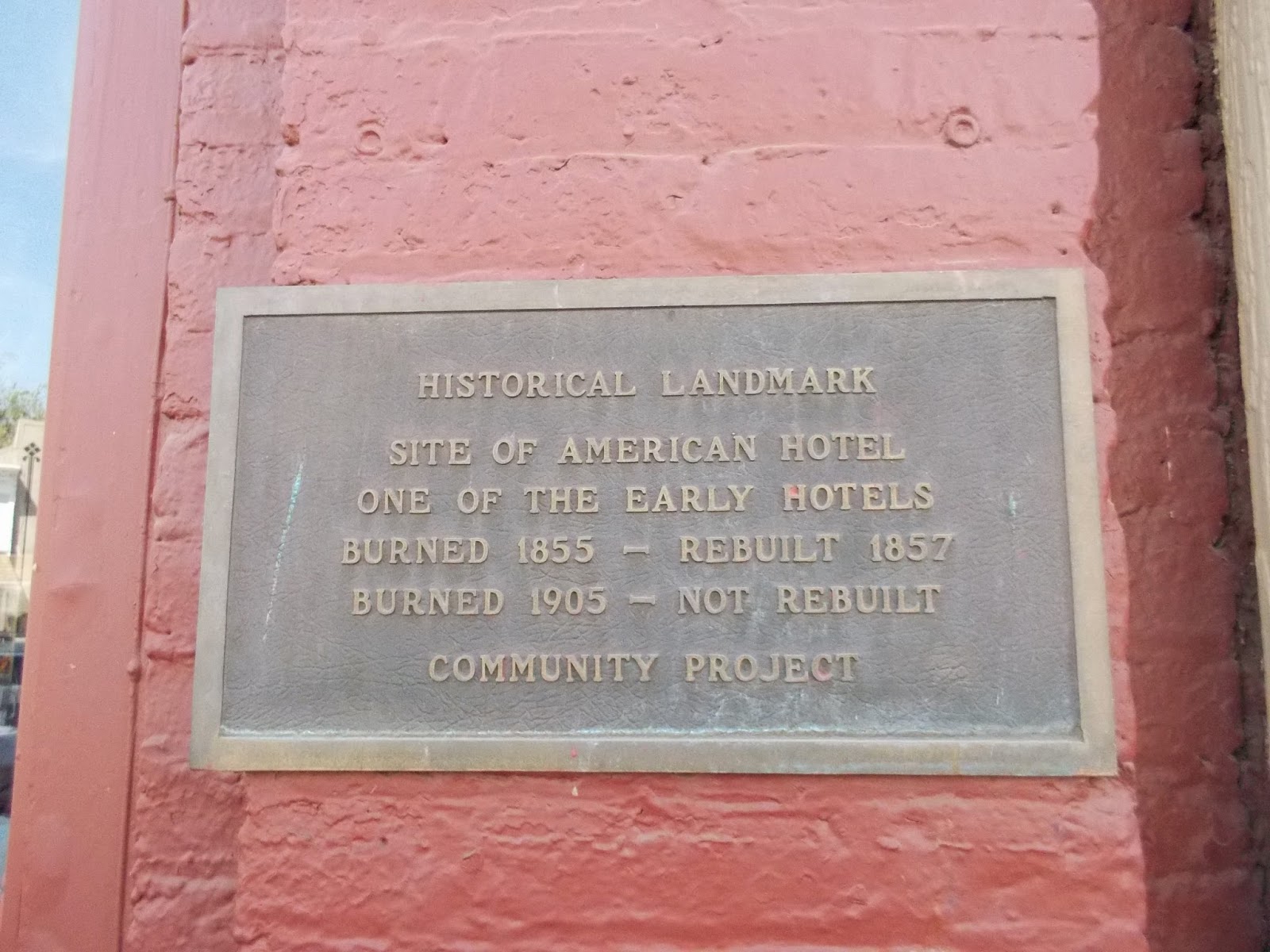
American Hotel Site - 226 Washington St.

"Site of American Hotel. One of the early hotels. Burned 1855 - rebuilt 1857. Burned 1905 - not rebuilt"

The American Hotel had the reputation of being the "best house in the mountains". Was on site from 1855 to 1905 when it was destroyed by fire. After, the Shanghai restaurant was here from 1925 until 2005.

Claude Chana - Washington & Park

"Adventurer and first fruit rancher in Placer County. In 1848 he found gold in the Auburn Ravine, which led to the settlement of a mining camp that later became Auburn"
"Lord Sholto Douglas Ch. 3, E. Clampus Vitus. 1975"

I tried to convince Dana to climb up into Mr. Chana’s gold pan but she wouldn’t…spoil sport. I think I could have had lots of laughs over that one.

Chana's group came from St. Louis, MO by oxen train and actually overtook the Donner party and made it over the Sierra's only 2 weeks before the Donner party was stuck.

The Chana group was on its way to Coloma when they camped in Auburn. It was here that Chana found gold in Auburn ravine.

Charbonneau - Lincoln & Park

"As an infant in 1805, he accompanied his parents Toussaint Charbonneau and Sacagawea, as they guided the Lewis & Clark Expedition. He lived along the American River Canyon & Manhattan Bars between 1848 and 1857. In 1861 he worked as a clerk at the Orleans Hotel, located near this site. Died in Oregon shortly after leaving Auburn in 1866."

His father nicknamed him "Pomp", a Shoshone term which describes the first born male child.

"Pompey's Pillar", a landmark 28 miles east of Billings, Mont, was named for him by Clark. Clark became very fond of the boy, and later saw to his education in St. Louis, Missouri

As an adult, he found favor with a Prince of Germany and spent 6 years traveling through Europe and North Africa and was back in California by 1829 where he served a year as "alcalde" for the Indians in the Mission San Luis Rey area.

The lure of gold never left him and he left California in 1866 for look for gold in Montana. He made it as far as Oregon where he contracted pneumonia and died.

Fire House #2 - Lincoln & Commercial
 
 "Erected in 1891 by the volunteer firemen of Auburn Hook and Ladder Company N.2 with funds raised by public subscription. Dedicated May 21, 1892. In continuous use until 1954."
 
Stationhouse #2 was saved from destruction in 1957 by moving it from one end of the block to the other. I never saw the reason it might have been destroyed but I wonder if that was the building of Interstate 80?


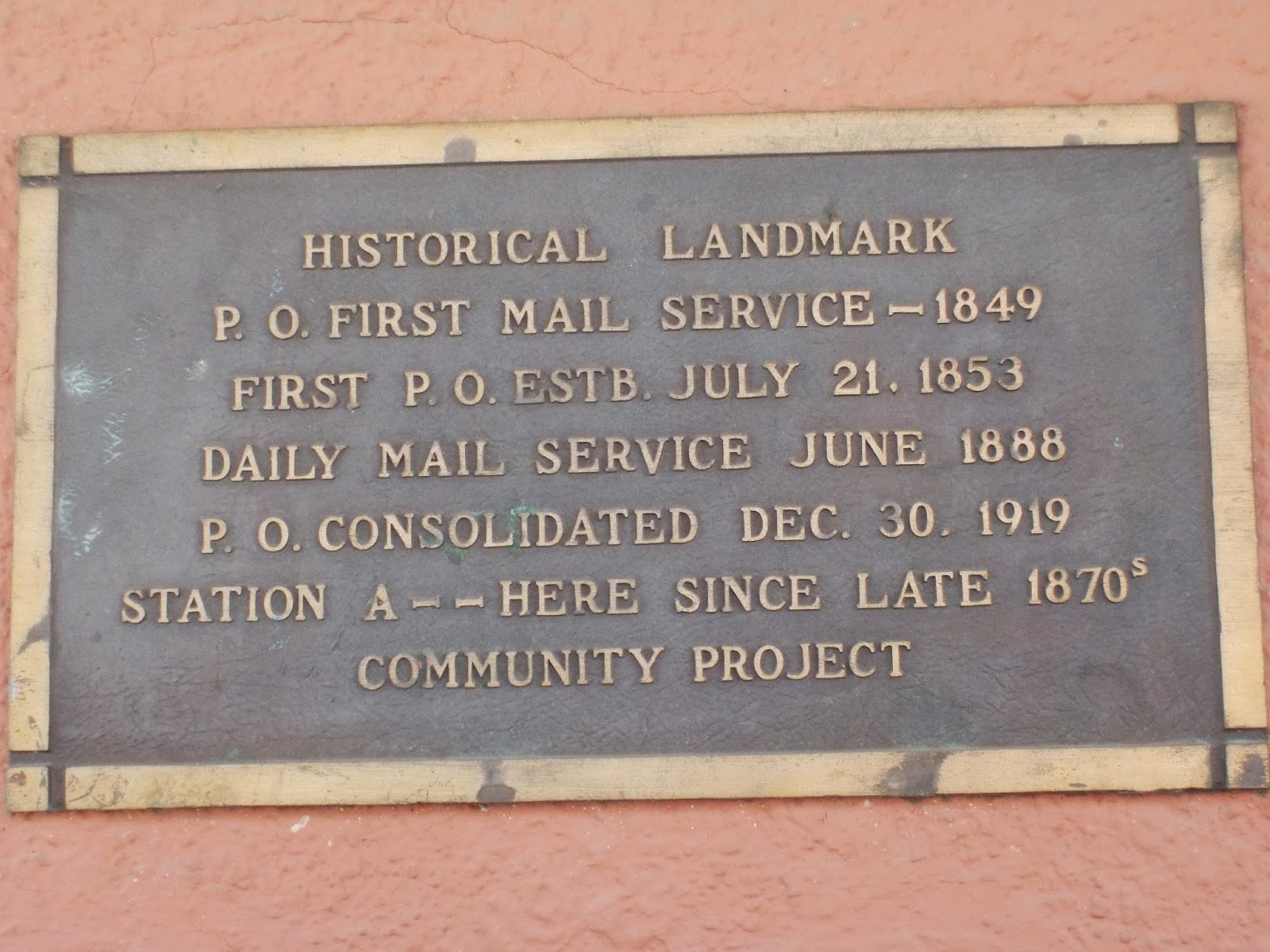
Auburn Post Office - 1583 Lincoln
 
"P.O. first mail service - 1849. First P.O. established July 21, 1853. Daily mail service June 1888. P.O. consolidated Dec. 30, 1919. Station A - Here since late 1870's"


Brye House - 1522 Lincoln
 
"This Colonial Revival home was originally constructed by Charles L. Simons. Simons came to Auburn in 1850 to try his hand at gold mining, but eventually became the owner of the saloon in town. The home was sold in 1901 to Fred Brye, A well-known local butcher. Brye and his family lived in the home for 20 years and made significant improvements, including the iron fence that surrounds the property today."

This is a home with many faces...In the 1940's; the home was converted into a 12-unit apartment house. The building was restored as a single-family residence in 1969, but only two years later it was converted into a restaurant. The property later became a Christmas store and, most recently, an office building.

Bosse-Morgan Building - 149 Sacramento

 
"Build in 1855 by Gordon. Early tenants included Gellespy & Co., Clothing and J. Harwood and Co. Tin and Hardware. Hop Sing operated a Chinese laundry here circa 1894 until his death in 1944. Purchased in 1897 by Henry Bosse, left to his daughters Carrie Gruhler and Minnie Morgan, it remained in the family until purchased in 1998 by Bruce and Judee Webb, Gypsy Wind Beads."

Joss House - 200 Sacramento
Originally, home of the Ling Ying Association. We learned while researching in Folsom that these Associations were started to help Chinese immigrants from particular areas of China.

This building not only held the Association meetings, but included a school and boarding house. They still have the original alter built in 1860 and is one of the few remaining wooden buildings in Auburn.

Chinese Houses - 220 Sacramento
 
"Among the earliest buildings. June 1855 fire started here. Burned 80 buildings."

Dana and I came upon the brick ruins shown above and looked everywhere for something explaining what it was. I never found anything but while looking at some old books online, I could see this was part of the “Chinese Houses”.

Placer County Courthouse - 101 Maple


When you walk towards the entrance to the Courthouse, you see a plaque that commemorates Auburns “hanging” area.

"Site of first public hanging area and graveyard. Third courthouse cornerstone laid July 4, 1894. Dedicated July 4, 1898".
Dana and I toured the museum. While she was interested in the replicas of dresses, I was looking at a sign that made me laugh..."Stage coach robbery was a popular form of outdoor fund-raising in California".

I have to say, I love having my family with me on these treks. None of us have any problem looking a little silly....


 Placer County's 1st Hospital - 219 Maple
   
Established in 1855, it was Placer County's first hospital. The State of California offered a grant of $1400. 00 to care for the indigent. It's now a museum open only upon appointment.

 
Lawyers Row - 299 Commercial

 
"Lawyer's Row - built 1855 by Anderson & Mills - many lawyers here through the years. Stars & Stripes paper pub. here 1867 to 1880's by Hart Fellows Community Project"

Willment General Store - 301 Commercial
 
"Site G. Willment General Store. Second floor was Mason Lodge. Built 1852 - Burned 1855. Rebuilt & dedicated Dec. 27, 1860"


Placer Press - 321 Commercial

"Nearby in this area 1850's Placer Press Paper 1855 to 1858. Above the Pioneer Livery Stable. Temple Saloon & Post Office 1855"  

Feldberg-Newman Clothing - 337 Commercial


"Jacob Feldberg - L. Newman, Clothing 1850's & 1860's. Magnolia Saloon - Star Bakery & Restaurant - H. Stone Groceries"

Placer County Bank - 345 Commercial
"First home of Placer Co. Bank. Estb. Oct. 5, 1887. Moved uptown 1913 & merged with Bank of California 1957"

Before the bank opened in this spot, it was the meeting place for the local militia called the "Auburn Greys". The current day 184th Infantry Army Regiment is the direct descendant of the "Auburn Greys". After that the bank opened in 1887 and stayed opened at this site until 1913. Moving into another location, it merged with Bank of California in 1957.

When we finally finished our day in Auburn, it was as I thought, getting back up Sacramento Street after walking all around Auburn was a bit of a chore. I really enjoyed Auburn and I'm not at all unhappy that I missed a few of the historical points of interest. Gives me an excuse to go back.