Sunday, April 24, 2016

Wagon Mound...Wagon Mound, New Mexico


DATE:  04/01/2016

HISTORICAL SITE:  Wagon Mound
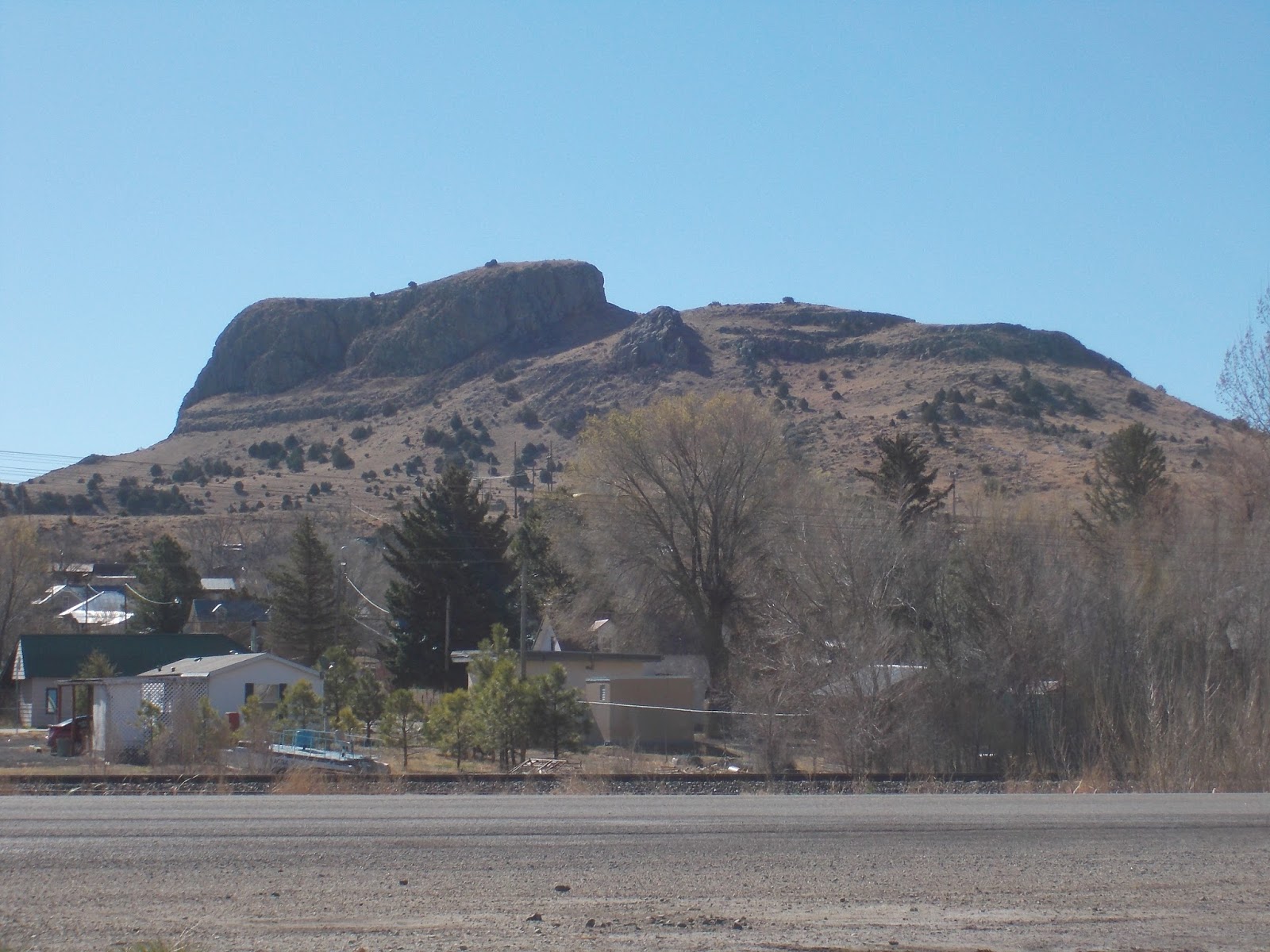
LOCATION:  East of Wagon Mound on U.S. 85, Mora County, New Mexico

MARKER #:  66000478

DEDICATED:  October 10, 1966
“This last great landmark on the Santa Fe Trail was named for its resemblance to the top of a covered wagon. At Wagon Mound, travelers could cross from the Cimarron Cutoff to Fort Union, which is located on the Mountain Branch of the Trail. The two branches joined south of here at Watrous.”

PERSONAL REFLECTIONS: 

Traveling north on I-25 from Santa Fe, there really isn’t a lot to look at. The landscape, a glimpse of what was to come for several days, was mainly open grassland.  As I promised myself during my very first trip, my gas gauge showed a quarter tank so it was time to start looking for a gas station. Then here comes this tiny little town called Wagon Mound and, oh, good…gas. In fact, it’s not even legally a “town”  but rather a “village”.

The village of Wagon Mound used to be quite prosperous and then the interstate was put in and traffic just sped by…not unlike the story of Route 66.

In 1900, the town boasted it had 4 saloons, a bank, a livery barn, 3 bakeries, 2 grocery stores, 2 hotels, 2 blacksmith shops, 2 restaurants, and a weekly newspaper in both English and Spanish.

The main line of the Atchison, Topeka and Santa Fe Railway went right through the town.

Pulling off the freeway, we see a sign for a historic site…bonus. So, we fill our tank and then come back to the marker.

Wagon Mound, a large hill near the town, so named because it looks like the top of a covered wagon is considered the “last great natural landmark on the Santa Fe Trail” and can be seen at least 60 miles from the North and East.

The Santa Fe Trail, which Wagon Mound is a part of, was one of America’s great trading routes. A total of 1,200 miles from Franklin, Missouri to Santa Fe, New Mexico, it was a vital trail for trading, the military and emigrants from 1821 to 1880.

The trail had many Way Stations, Trading Posts and military Forts.

Even after the territory was ceded by Mexico after the war, trade between Mexico, south of the trail, and the United States flourished for many years.

All along the trail, travelers used natural landscape features to help them navigate. Places like Pawnee Rock, Rabbit Ears Mountain and Wagon Mound aided the travelers.

As you can imagine, Wagon Mound, being 6,930 feet high, and resembling oxen pulling a wagon, was very easy to see. Care needed to be taken to recognize this site as the area was the Cimarron Cutoff point to Fort Union.

The area quickly became a favored spot for travelers to rest. The abundance of green grass and water was appealing, yet just 2 miles north, the Santa Clara Spring camping spot became the site of many Indian ambushes.

The mound was not only a navigational tool and a promise of a good rest, but became a warning to travelers about the local Indians.

As the number of travelers grew, the relationship with the Indians got worse as their traditional way of life was interrupted more and more. This area had been home to many major tribes including Comanche, Kiowa, Cheyenne, Arapaho, Plains Apache, Osage, Kansas (Kaw), Apache, Ute, and Pueblo Indian.

The U.S. Government, along with Mexico, started providing escorts on the trail further enraging the Indians until the “Mail Train Massacre” in May of 1850 where a mail train going west was attacked and all 10 men were killed. The bodies weren’t found for a couple of weeks until the eastern mail train came upon them.

It was estimated there were over 100 Indians and up until this point, a train with 10 men were considered safe. The Government increased its raids and attacks against the Indians; resulting in the Indian population being pushed back and onto reservations.

During the civil war, with the U.S. Army engaged elsewhere, the cutoff was considered too dangerous with Confederate raiders and Indians so traffic basically stopped until the war was over.

And once the railroad made its way through the area, the trail, given time, was abandoned for the new transportation option.

Chicago Cubs - Spring Training...Mesa, Arizona


DATE:  03/29/2016 & 03/30/2016

SITE:  The Chicago Cubs – Spring Training

LOCATION:  2330 W. Rio Salado Parkway, Mesa, Maricopa County, Arizona

PERSONAL REFLECTIONS: 

Honestly, there wasn’t anything “historic” about our visit to watch the Chicago Cubs play during Spring Training. Dirk has been a long time Cubs fan and this was a great opportunity for us to take in a couple of games. He was pretty darn excited and I loved experiencing it with him.

 In 1876, the Cubs, then known as the Chicago White Stockings, were one of the original teams in the National League. In 1890, they were known as the Chicago Colts and finally becoming the Chicago Cubs in 1907.

The last time the Cubs won the World Series was in 1907 and 1908. The team has appeared in 7 World Series since than; losing each time. The Cubs have not won the World Series in 107 years, the longest championship drought of ANY North American professional sports team…meaning all sports, not just baseball.

There is a rivalry between the Cubs and the St. Louis Cardinals. In 1885, a version of the World Series was played against the St. Louis Brown Stockings. They tied in 1885 and St. Louis won in 1886. This is often touted as the reason for the extreme rivalry that exists even today. Let me tell you…I’ve seen it first hand!

In 1916, the Cubs made the move from the “West Side Grounds” to “Weeghman Park”, where they still are located although it is now called Wrigley Field.

A funny story exists about a goat and a curse. I guess in 1945, a person brought a goat to a game but was eventually thrown out because of the stench. He was said to have uttered “The Cubs, they ain’t gonna win no more”. True or not, there are people who believe in, and still talk about, the “curse”.

In 1886, the Chicago White Stockings held their first spring training camp in Hot Springs, Arkansas. The idea was to get the team ready for the season with practice and then utilizing the hot springs after. The team successfully won the pennant that year and other teams started showing up in Hot Springs.
 
Before settling in Mesa, Arizona, the Cubs also held spring training in New Orleans; Champaign, Los Angeles, Santa Monica, French Lick, Tampa, Pasadena, Long Beach, Scottsdale and Catalina Island.

From 1979 to 1996, the Cubs trained and played at the original Hohokam Stadium until it was demolished. The rebuilt Hohokam Stadium housed the Cubs from 1997 to 2013. The Cubs established records for both single game attendance and overall season attendance.

The citizens of Mesa, by ballot measure, voted to finance a new facility to house spring training for the Cubs in order to keep the Cubs in Mesa and the dollars flowing from the tourists who flock there each year. Initially called Wrigleyville in the plans, the field opened as “Cubs Park” in 2014.

For their $99 million dollars, Mesa got a promise from the Cubs to stay 30 years with an option for 50. If the Cubs were to leave before the deal is through, they must pay $1 million for each missed year.

The name was changed to “Sloan Park” in 2015 after a naming rights deal with the ballpark.

The park is really beautiful. The facility, the largest spring training facility in MLB, has a capacity for 15,000 fans and the two days we were there? They filled them. As an aside, it was announced that the Cubs had the largest attendance of any MLB team in spring training this year.

We were able to see the Cubs beat the Oakland A’s; 9 to 5 and the Colorado Rockies; 10 to 0.

Dirk swears I’ll be a Cubs fan and darn it if I don’t know more about this baseball team than any others. 

By the way, Dirk has found a particular song on the jukebox at the Pub he hangs out with friends at. The song, called “Go Cubs Go”, isn’t all that popular, as you can imagine, in the midst of St. Louis Cardinals territory. Dirk takes a lot of enjoyment playing that song. In fact, because his phone is hooked up to the jukebox, he was able to play the song once when he was at home watching a Cubs win.

Friday, December 11, 2015

Stone Chapel...Springfield, Missouri


DATE:  November 14, 2015

HISTORICAL SITE:  Stone Chapel


LOCATION:  E. Central Street, Springfield, Greene Co., Missouri

MARKER #:  82000583

DEDICATED:  October 21, 1982

Stone Chapel   Long recognized as a symbol of Drury College, Stone Chapel resulted from a gift by Mrs. Valerie G. Stone, Malden Mass., and named for her. Cornerstone was laid Nov. 16, 1880. Fire loss delayed completion until 1892. Special features: First bldg. made of stone, pipe organ, and stained glass windows.

MARKER PLACED BY:  Springfield Historical Sites Board  City-County Bicentennial Committee

PERSONAL REFLECTIONS: 

Like Dirk and I seem to do way too often, we arrived at the chapel just as dusk was falling.

The chapel is located on the grounds of Drury University, which was established in 1873. It was named Stone Chapel because it’s the oldest stone structure in Springfield…or so I thought! It was actually named Stone Chapel after Valerie G. Stone, one of its benefactors who gave the initial $5,000.00 contribution but then another $20,000.00 later. So, it was named after her.

In spite of a fierce snowstorm, the laying of the cornerstone on November 16, 1880, was very well attended. The cornerstone was put in place during a heavy snowstorm on November 16, 1880.  

I was so fortunate during this trip. I had packed for cold weather at Dirk’s insistence, although really, California’s answer to winter is to put long sleeves on our summer clothes so the material is just as thin…just with long sleeves. I brought along only 2 short sleeve shirts and probably wore those more than all my nice warm sweaters. People complained about the unseasonably warm weather, but I just smiled and thanked the El Nino we are having this year.
 
On December 12, 1882, classes were in session on the 2nd floor when an explosion ripped through the church as the furnace exploded. Thankfully, everyone got out unhurt but their nice new chapel was destroyed. It was said that most of the town watched the bell tower come crashing down.

It took another decade to rebuild the chapel on its original foundation at a cost of $45,000.00

The first commencement class ceremony to be held in the chapel was in 1892…all female.

In 1906, the Chalfant Organ was put in place where it is still used today

This has nothing to do with the church, but I thought it was an interesting story nonetheless.

Near the church, on the Drury campus are two cannons left behind from the Civil War era. They moved around Springfield quite a bit before calling Drury University home in the late 1800’s.

They always sat free, but sometime soon after the cannons were placed on campus, one went missing while the other was often borrowed for parades, memorials and other celebrations.

Then in 1905, Springfield High School borrowed it and for some reason the Drury campus manager told them they could keep it. Well, the Drury students didn’t agree, so they went and took it back. They mounted it on a solid stone pedestal in its current location, facing the street.

In 1913, while cleaning out a warehouse area, the second cannon turned up at the Frisco shops. It took some negotiation, but the cannon ended up back on Drury University property where it was mounted across from the other one.